

Clinical Selection Guide

Types of Hearing Aids: Which Is Right for You?

Choose hearing aids that are comfortable, fit your routine and work for your level of hearing loss.

Explore hearing aid options designed to suit your hearing needs and lifestyle.

Audiology Consultation — Exploring Types of Hearing Aids with Dr. Penny Heba
Audiologist-Led Care Expert diagnostic testing & personalized fitting
Penny Heba, AuD

“There isn’t one hearing aid that’s best for everyone,” says audiologist Penny Heba, AuD. “The right choice depends on your hearing loss, your lifestyle and what you need from the device.”

Penny Heba, AuD Doctor of Audiology & Clinical Specialist Insights featured from Cleveland Clinic Audiology
What Are the Types of Hearing Aids?

The 4 Key Differences That Set Them Apart

There are several different types of hearing aids. Some are more noticeable than others. Some can connect wirelessly to your phone and other devices. Some are available over the counter (OTC), while others require a prescription. “OTC hearing aids aren’t appropriate for more than a mild hearing loss,” Dr. Heba says. “For the right hearing loss, they can be a very good option.” But all hearing aids share the same primary goal: helping you hear conversations and everyday sounds more clearly.

Over-the-Counter (OTC) vs. Prescription Hearing Aids

“OTC hearing aids aren’t appropriate for more than a mild hearing loss,” notes Dr. Heba. “For the right hearing loss, they can be a very good option.” However, moderate, severe, or asymmetrical hearing difficulties require a comprehensive clinical hearing test and prescription fitting by an audiologist to prevent further auditory deprivation.

01

Where they sit in or on your ear

Behind the ear (BTE/RITE) with discreet acoustic tubing, or custom-molded inside your concha or deep canal (ITE/ITC/CIC).

02

How discreet and visible they are

Ranging from ultra-discreet, virtually invisible canal fits to sleek, ergonomic designs color-matched to your hair or skin tone.

03

The severity of hearing loss treated

Engineered with tailored acoustic amplifiers specifically designed for mild, moderate, severe, or profound hearing loss.

04

Technological advancements

Lithium-ion overnight rechargeability, direct Bluetooth® low-energy audio streaming, hands-free phone calls, and AI sound filtering.

Hearing Aid Styles

The 5 Core Types of Hearing Aids

See how each style looks when worn on the human ear. Click any style to dive into hearing loss suitability, clinical advice, and daily handling considerations.

Real Ear Placement
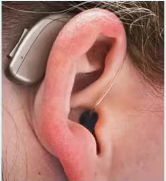
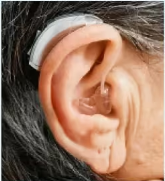
Behind-the-ear (BTE) worn behind ear
Anatomy Fit: Sits securely behind the outer ear, anchored with an earmold or thin tube.
Mild to Profound Hearing Loss Standard & Custom Molds

Behind-the-ear (BTE)

As the name implies, behind-the-ear (BTE) hearing aids house all the electronics — including a speaker — behind your ear. A custom earmold or thin tube connects the device to your ear. BTE hearing aids can be an option for all levels of hearing loss, from mild to profound.

“They’re often a great choice because they can accommodate a wide range of hearing needs while offering many of the latest features,” Dr. Heba explains.
Handling & Dexterity Note: Because BTE devices have multiple parts, they may be more difficult to insert and remove if you have arthritis or limited dexterity in your hands.
Real Ear Placement
Receiver-in-the-ear (RITE) worn on ear
Anatomy Fit: Ultra-thin wire leads directly to a miniature speaker housed inside the ear canal.
Mild to Severe Hearing Loss Most Popular Style

Receiver-in-the-ear (RITE / RIC)

Receiver-in-the-ear (RITE) hearing aids look similar to BTE devices. And like BTE hearing aids, they require you to be able to handle small parts. Also, like BTE devices, the main body sits behind your ear. But instead of housing the speaker there, a thin wire connects it to a receiver that sits inside your ear canal. That means these types of hearing aids may provide a more natural listening experience than BTE devices.

RITE hearing aids work well if you have mild to severe hearing loss, giving you an open, airy fit that minimizes any plugged or echoey sensation in your own voice.
Handling & Dexterity Note: The thin wire requires gentle handling when inserting and removing, and the ear dome needs routine cleaning to stay free from wax.
Real Ear Placement
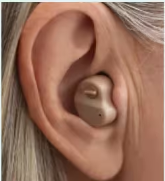
In-the-ear (ITE) worn in outer ear
Anatomy Fit: Custom crafted from your ear impression to fit seamlessly inside your outer ear concha bowl.
Moderate to Severe Hearing Loss Full-Shell & Half-Shell

In-the-ear (ITE)

Instead of sitting behind your ear, in-the-ear (ITE) hearing aids fit inside your concha. That’s the bowl-like part of your outer ear. Some fill the entire space (full-shell), while others are slightly smaller (half-shell). ITE hearing aids are often recommended for people with moderate to severe hearing loss, and they may be easier to handle than smaller devices.

“If inserting and removing very small hearing aids is challenging, an in-the-ear style can be easier to manage,” Dr. Heba confirms.
Handling & Dexterity Note: Because the custom shell rests in the outer ear, it is more noticeable than canal styles and requires proper custom ear impressions.
Real Ear Placement
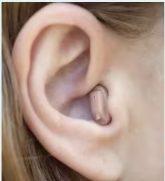
In-the-canal (ITC) worn inside canal
Anatomy Fit: Fits snugly inside the ear canal for exceptional discretion, with CIC fitting even deeper.
Mild to Moderate Hearing Loss Maximum Discretion

In-the-canal (ITC & CIC)

If keeping your hearing aids as discreet as possible is important to you, an in-the-canal (ITC) device may be worth considering. They work best for mild to moderate hearing loss. These hearing aids sit deeper in your ear canal, making them less visible than larger hearing aids. Some people may even qualify for completely-in-the-canal (CIC) hearing aids, which fit even farther into your ear canal.

Deep canal placement allows the outer ear to naturally funnel sound, providing excellent localization when identifying where sounds are coming from.
Handling & Dexterity Note: The tradeoff is that their smaller size can make them more difficult to insert, remove and maintain. They typically require very small batteries, too, which can be tough for some people to handle.
Real Ear Placement (Dual Fitting)
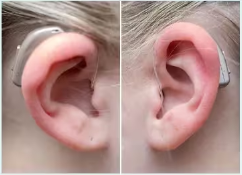
CROS / BiCROS worn on both ears
Bilateral System: Worn on both ears — microphone transmitter on poorer side, active hearing aid on better side.
Dual-Ear Signal Routing
Poorer Ear (Weaker Side)
Microphone Transmitter
Wireless Audio Stream
Better Ear (Receiving Side)
Receiving Hearing Aid
Single-Sided Deafness & Asymmetric Loss Single-Sided Deafness Solution

CROS / BiCROS Systems

CROS and BiCROS hearing aids are designed for people who have much better hearing in one ear than the other. CROS (Contralateral Routing of Signal) can be a good option if you have severe or profound hearing loss in one ear and little to no hearing loss in the other. BiCROS (Bilateral Contralateral Routing of Signal) is intended for people with severe or profound hearing loss in one ear and mild to moderate hearing loss in the other. With both systems, you wear a microphone on your poorer-hearing side. It sends sounds wirelessly to a hearing aid worn on your better-hearing side.

CROS System

For severe or profound loss in one ear and normal hearing in the opposite ear. Transmits sounds from the non-hearing side without adding extra amplification to the normal ear.

BiCROS System

For severe or profound loss in one ear and mild-to-moderate loss in the other. Transmits sounds across while simultaneously amplifying audio for the better ear.

“With these types of hearing aids, sounds picked up on your weaker side are transmitted to your better-hearing ear,” Dr. Heba explains. “That makes it easier to hear conversations regardless of where someone is standing.”
Handling & System Consideration: Both ears are fitted: one side captures sound via wireless transmitter, and the other receives amplified sound. Continuous audio streaming requires reliable rechargeability.
Personalized Audiological Assessment

Which Hearing Aids Are Right for Me?

Choosing hearing aids isn’t just about picking the smallest device or the latest technology. It’s about finding one that fits your hearing needs and your everyday life.

“It’s important to choose something that’s comfortable and works well for your routine,” Dr. Heba advises. “Your hearing aids should feel good, work well and be convenient for you to use.”

When looking for hearing aids, consider these 5 key factors:

  • 1. The severity of your hearing loss A diagnostic audiogram confirms if your loss is mild, moderate, severe, profound, or asymmetrical.
  • 2. The size and shape of your ear Canal narrowness, sharp bends, or surgical ears dictate whether an in-canal custom fit or behind-ear open fitting is ideal.
  • 3. How comfortable you are handling small devices If arthritis, tremors, or limited hand vision are factors, an ITE style or rechargeable BTE with drop-in charging is significantly easier to operate.
  • 4. Features that matter to you Prioritize rechargeable batteries, hands-free Bluetooth phone streaming, direct TV links, or discreet smartphone app volume control.
  • 5. Your personal preferences and lifestyle Consider your acoustic environments — quiet home living, active outdoor exercise, crowded restaurants, or professional business conferences.
Auditory & Brain Wellness

Why Consistent Hearing Treatment Protects Your Brain & Health

Finding hearing aids that you’ll use consistently isn’t just about better hearing. Left untreated, hearing loss can make you feel isolated and can affect your mental health and even your memory and brain function.

5x Higher Dementia Risk

Medical research confirms that severe untreated hearing loss significantly increases cognitive strain, leading to accelerated auditory cortex atrophy and elevated dementia risk over time.

Patient Inquiries

Frequently Asked Questions About Hearing Aid Types

Islandwide Clinical Fitting Centers

Not Sure Where to Begin? We’re Here for You.

If you’re not sure where to begin, that’s OK. There are a lot of options, and they deserve a close look. An audiologist can help you find the right hearing aids so you can hear well, communicate with confidence and live a fuller life.